AnnouncementsMicrogrid Initiatives supports successful intervention at California PUC Photo courtesy Rincon Band of LuiseƱo Indians
PALA INDIAN RESERVATION, Dec. 11, 2025: The California Public Utilities Commission (CPUC) approved a decision on December 4 to revise extension policies under a popular energy storage rebate program, salvaging at least $25 million in funding for more than 60 projects serving many California Native American Tribes and disadvantaged communities (DACs). (See CPUC D2512003 (Dec. 4, 2025).)
The Self-Generation Incentive Program (SGIP) non-residential energy storage rebates were at risk because the resilient clean energy projects that planned to utilize them were delayed for reasons beyond their hosts’ control. The SGIP Handbook allowed only limited extensions, exposing eligible recipients to major financial risks in cases where vendors and contractors went bankrupt, or supply chains for key equipment became disrupted – just two examples of factors that set back the affected clean energy projects. For Tribes and communities that invested in energy storage systems on the promise of the SGIP rebates, the strict extension policy threatened to punish them for persevering through challenges they couldn’t foresee or control. Starting in 2024, delays began to threaten SGIP equity resiliency rebates reserved for numerous projects hosted by several Tribes, including the La Jolla Band of Luiseño Indians, Manzanita Band of the Kumeyaay Nation, Pala Band of Mission Indians, Rincon Band of Luiseño Indians, and San Pasqual Band of Mission Indians. Their projects were delayed by uncontrollable factors such as vendor bankruptcies, supply chain disruptions, and complications with utility grid interconnection. Working through the Tribal Energy & Climate Collaborative (TECC), an initiative of the Southern California Tribal Chairmen’s Association (SCTCA), the Tribes marshaled a joint intervention at CPUC. The TECC team’s outreach identified numerous Tribes and DACs with more than 60 projects facing SGIP deadline risks. These projects represent nearly 33 megawatt-hours of energy storage capacity, and SGIP rebates valued at more than $25 million. And these likely comprise a fraction of all projects with SGIP rebates at risk. Although some projects may have been canceled or completed in the interim, the CPUC Energy Division in July 2025 identified a total of 236 active non-residential equity projects with $177 million in reserved SGIP rebates that could benefit from additional extensions. (See CPUC Proposed Decision in R2005012, p.18 (Aug. 29, 2025).) Nearly 30 different Tribes, communities, and other project hosts submitted comments and letters to CPUC in support of the requested additional SGIP extensions. (See list below for reference.) Their projects were designed to provide solar and storage microgrids for a wide range of essential facilities, such as health clinics, elder care facilities, fire stations, police stations, water and waste water systems, schools and colleges, neighborhood grocers, and emergency public shelters. The Tribal-led coalition succeeded in convincing CPUC to revise SGIP policies to provide up to four additional six-month extensions for projects delayed for reasons beyond their hosts’ control. “Before the CPUC revised the SGIP extension policy, we were facing the need to cancel resilient energy projects for several essential Tribal facilities,” said Wesley G. Ruise Jr., Chairman of the La Jolla Band of Luiseño Indians. “The new extensions will allow us to save nearly $300,000 in rebates, and to finish our projects to provide backup power while reducing energy costs for the La Jolla Band.” The outcome marked a significant milestone for TECC, which among other things supports SCTCA member Tribes in monitoring and facilitating engagements with California agencies and policy makers. Such policy engagements are funded in part by a CPUC grant under its Equity and Access Grant Program, which awards grants to advance the role of Tribes and under-resourced communities in utility and transportation policy-making and facilitating clean-energy access. (For more information, visit the program website: CPUC Equity and Access Grant Program.) “This successful outcome demonstrates the importance of CPUC’s Equity & Access grant program, which enabled our TECC policy team to amplify the voices of Southern California Tribes who otherwise would have gone unheard by the Commission,” said Denis Turner, SCTCA’s Executive Director. “SCTCA is grateful for CPUC’s support and consideration, as well as the support of the many Tribes, communities, and legislators who signed on to our intervention efforts.” In addition to engaging multiple California Tribes and DACs, the TECC policy team partnered with the Local Government Sustainable Energy Coalition (LGSEC) in filing its original petition for modification with CPUC. Working with SCTCA member Tribes and various California cities, counties, and school districts, the TECC team garnered additional support from 26 California legislators led by Assemblymember David Avarez and Senator Brian Jones, who endorsed a letter to Commissioner Alice Reynolds in support of the final decision in CPUC Rulemaking 12-11-005. During the Thurs., Dec. 4, 2025, CPUC meeting, multiple commissioners spoke in favor of the decision and commended the perseverance of the Tribes and DACs that participated in the proceedings. Commission President Alice Reynolds stated, “We have observed that the non-residential equity category has experienced higher cancellation rates and higher use of extensions, [than other projects], so I do think it is appropriate to rewrite the rules to support completion of these projects.” Commissioner John Reynolds added that the decision “creates a much more practical pathway for access to program funds.” Commissioner Darcie Houck noted that 64% of the equity projects are already in their third extension, many due to delays stemming from inherent characteristics of the applicants. “We want to ensure our programs are successful and equitable for all Californians,” Houck said. “I want to thank… all of the parties that provided key information that supported us in making decisions in this process, specifically the Southern California Tribal Chairman’s Association and school districts” that submitted comments and information to inform the proceeding. Commissioner Karen Douglas echoed the sentiments of other commissioners. “We are all committed to supporting projects that address the needs of underserved, environmental [justice], and social justice communities under this program,” she said. “I understand the facts surrounding these projects, and believe that in this instance, these equity projects, at the tail-end of [the program] timeline, need flexibility,” she said. “I am very supportive of this decision. I salute the years-long effort of local governments and Tribal authorities to bring these projects to their communities.” Project Hosts that Filed Letters Supporting SCTCA’s Petition for Modification: Ampla Health, City of Arcata, City of Irvine, City of Santa Monica, Community Mutual Water Co., Fallbrook Food Pantry, Free Clinic of Simi Valley, La Jolla Band of Luiseño Indians, Laguna Food Pantry, Lake Casitas Park Store, Lundy Mutual Water Co., Mammoth Lakes Fire Department, Manzanita Band of the Kumeyaay Nation, Mountain Vista Ojai, Open Door Community Health Centers, Pala Band of Mission Indians, Planned Parenthood of California Central Coast, Republic Services, Rincon Band of Luiseño, San Pasqual Band of Mission Indians, Sanel Valley Market, Sisar Mutual Water Co., St. Mary’s Gas & Mini Mart, and San Diego Unified School District. (See SCTCA Comments, Appendix A). ABOUT SCTCA: The Southern California Tribal Chairmen’s Association (SCTCA) is a multi-service non-profit corporation established in 1972 for a consortium of 26 federally recognized Indian Tribes in Southern California. The primary mission of SCTCA is to serve the health, welfare, safety, education, cultural, economic and employment needs of its Tribal members and descendants in the San Diego County urban areas. A board of directors comprised of Tribal chairpersons from each of its Member Tribes governs SCTCA. SCTCA coordinates and administers numerous grant programs for its members and the Southern California Indian community, including: Tribal Temporary Assistance to Needy Families (TANF), Law Enforcement, Food Commodities, Information Technology Services, Rincon Child Development Center, Adult Vocational Training, Career Development Center, Low Income Home Energy Assistance Program (LIHEAP), the Library Program, Child Care Development Services, Tribal Digital Village (TDV) and Resource Prevention Program. ABOUT TECC: The Tribal Energy & Climate Collaborative (TECC) is a partnership between SCTCA, SCTCA’s Member Tribes, and Prosper Sustainably, LLC. TECC’s mission is to identify and advance the clean energy, climate change, and related economic and workforce development goals of SCTCA Member Tribes. TECC’s program areas include: 1) Capacity Building and Technical Assistance, 2) Economic and Workforce Development, and 3) Policy and Regulatory Advocacy. CONTACT: Joshua Simmons, Co-Director Tribal Energy & Climate Collaborative Phone: 805.617.5685 [email protected] Barona Tribe Releases RFPs to Build Four Microgrids at Two SitesCasino Microgrid to Advance Non-Lithium Long-Duration Energy Storage Technology with CEC-Funded RD&D and Commercialization Scope
April 23, 2025: The Barona Band of Mission Indians today released a pair of requests for proposals (RFP) to develop, engineer, install, commission, and test a series of solar+storage microgrids at two sites at the Barona Reservation in Southern California. The solicitation targets the Barona Government Building and the Barona Resort & Casino Campus for installation of solar photovoltaic (PV) arrays totaling 5,300 kW and battery storage totaling 2,350 kW / 10,070 kW.
In addition to commercial battery energy storage systems (BESS) for three of the four sites, the project also specifies a non-lithium long-duration energy storage (LDES) system for the part of the project serving the Barona Casino, with associated research, development, demonstration (RD&D) and commercialization scope. The project's scope for advancement of non-lithium LDES technologies is supported by a grant from the California Energy Commission. The Barona Band pre-qualified three battery vendors for the LDES system, including Eos Energy, ESS Inc., and Invinity Energy Systems. Questions and feedback in response to the RFPs are due May 20, 2025, after which revised releases will be issued. Final proposals must be submitted by June 30, 2025. Bidders must participate in at least one of two site walks, the first of which is scheduled for May 8. Interested parties should Contact Microgrid Initiatives to receive RFP materials and updates. The project solicitation process is led by Barona Contractor Prosper Sustainably LLC, with support from Microgrid Initiatives. Any parties that attempt to circumvent the procurement process by contacting the Tribe directly may be disqualified from consideration. ■ Rincon Tribe closes financing for solar microgrid portfolioMicrogrid Initiatives supports development of solar microgrids at Harrah's Resort, Rincon Government Center, and other vital facilities
Aug. 26, 2024: SAN DIEGO - Bridge Renewable Energy, a subsidiary of Bridge Investment Group Holdings Inc. (NYSE: BRDG) (“Bridge”), Solaris Energy and WATTMORE, are thrilled to announce their successful closing and the kickoff of 1.8 MW of solar and storage projects across multiple facilities on the Rincon Reservation in San Diego County, CA. This deal marks the completion of nearly three years of planning, designing, grant writing and finance modeling.
“We are very excited to move forward on this new project and are committed to providing renewable energy to our people, residents, and businesses on our reservation. Together with our new partners, we are building a cutting edge solar + storage project to lower our carbon output, and decrease our monthly energy costs,” said Chairman Bo Mazzetti of the Rincon Tribe. “We are thrilled to have reached this milestone and are grateful for our partnership with the Rincon Tribe. We believe this project demonstrates the exceptional value that solar and energy storage projects can deliver to reservations, communities, and other commercial applications. We extend our appreciation to all the parties involved in this transaction and look forward to helping bring the project to full operation,” said Bridge Renewable Energy’s Adam Haughton. Solaris Energy and WATTMORE co-developed this project using complementary skill sets to combine incentives from the new federal Inflation Recovery Act signed into law in 2022 with State and federal grants, allowing maximization of the economics and impact for both the Tribe and the investment partner Bridge Renewable Energy. “We’re proud to bring our passion for creative, impactful, Tribal projects and decades of renewable energy financing and development expertise to the table to help bring this project to fruition,” stated Solaris Energy’s CEO, Nick Perugini. “We’re so grateful for the Tribe’s continued commitment and for our partners in storage and financing, as well as Prosper Sustainability, Microgrid Initiatives, the Department of Energy, and California Energy Commission who all dedicated substantial resources and conducted an exceptional job to get us to this point,” added Perugini. WATTMORE’s CEO, Jonathan W. Postal (JW), said, “Energy storage paired with solar is the key to our clean energy future. This project is a great example of perseverance and commitment to bringing multiple types of technology together to drive carbon reduction and cost savings for a great customer.” READ MORE California Energy Commission Awards $9M to Barona Band for Flow Battery StorageMicrogrid Initiatives (formerly Microgrid Institute) supports Prosper Sustainably as Project Manager and Owner's Representative for Community Long Duration Energy Storage Project
June 19, 2024: Redflow Limited (ASX: RFX), a global leader in clean energy storage, is pleased to announce that its zinc-bromine battery technology, which was identified as the preferred energy storage technology for the Barona Band of Mission Indians’ 6.6 MWh LDES project (refer ASX announcement 2 February 2024) has formally received grant funding approval from the California Energy Commission (CEC).
The CEC has approved funding for $9 million ($A13.5m) with matched funding by the Barona Tribal Community of $4.1 million ($A6.1m) for the project with a total project budget of approximately $13.2 million (A$19.6m). The approval will now allow Redflow to work with Barona Band Project Consortium, which includes Prosper Sustainably, Microgrid Initiatives, and strategic partner Ameresco, a leading cleantech integrator and renewable energy asset developer in the US, to commence project planning. Anticipated deployment of the 6.6 MWh Redflow system is expected in FY26 with formal timetable to be agreed with the end customer. Redflow expects its revenue on a $/kWh basis for this project would be roughly consistent with similar projects being delivered in the U.S. Redflow also expects payment milestones to be broadly similar to other US projects. Redflow CEO and Managing Director Tim Harris said that approval of funding from the CEC demonstrates Redflow’s technology capabilities at a commercial multi-megawatt hour scale, and further evidence of demand in its core markets of Australia and the United States. Redflow’s Chief Commercial Officer and President North America Mark Higgins said; “The Barona battery will be Redflow’s fourth multi-megawatt hour project in California involving the CEC as a funding partner and reflects the close partnership we have developed since our first CEC-sponsored project with Anergia in 2021. Redflow has proven its technology in the California market, and our LDES technology is highly aligned with California’s decarbonisation goals. We believe this is reflected in the CEC’s ongoing confidence in selecting projects that make use of Redflow’s leading LDES solution.” READ ORIGINAL ANNOUNCEMENT San Pasqual Government Complex Microgrid Begins OperationsMicrogrid Initiatives (formerly Microgrid Institute) supports Prosper Sustainably as Project Manager and Owner's Representative for Advanced Integrated Microgrid Project
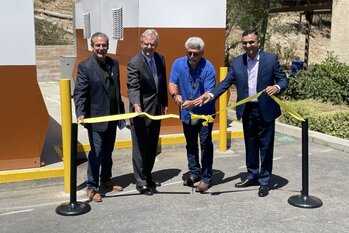
Microgrid Initiatives (formerly Microgrid Institute) provided a variety of services to support development of the San Pasqual Microgrid, including grantwriting, project management, and owner's representation.
June 9, 2022: Nestled within a rolling mountainous landscape roughly 50 miles from the Pacific coastline in northern San Diego County, the arid valleys of the San Pasqual Reservation bask in abundant sunshine throughout the year.
Taking advantage of this area’s abundant natural resources, the San Pasqual Band of Mission Indians has followed an environmentally conscious approach of working with the land and the climate to support community energy sovereignty and security. “As a Tribe, we want to be energy independent. That means tapping into our natural resources—not oil or coal—but the sunlight,” explained John Flores, Environmental Director and Water Manager for San Pasqual. In June 2022, the Tribe commissioned a hybrid solar-storage-liquid propane microgrid system to boost energy reliability and resilience on the Reservation. Designed to maintain critical building operations during emergency events, the microgrid will help maintain uninterrupted power supply to five essential tribal government facilities, including the administrative building, housing and security facilities, fire department, the education and preschool buildings (which also serve as the local emergency shelters), and the wastewater treatment plant. READ MORE Microgrid Institute Supports National Meeting on Tribal Pollution Prevention with Energy Storage

Sept. 1, 2020: In cooperation with the Pala Band of Mission Indians, San Pasqual Band of Mission Indians, and Prosper Sustainably, Microgrid Institute Director Michael Burr will join a national roundtable meeting on energy storage technologies and applications on Sept. 17, 2020. The meeting, sponsored by the U.S. Environmental Protection Agency (EPA), is part of the Intertribal Pollution Prevention Project (TribalP2Action.org), which Microgrid Institute supports with energy assessment, project management, and stakeholder engagement services.
Energy storage technologies are taking center stage as tribal businesses, governments, and other organizations seek to improve their self-reliance and resiliency against utility outages. Energy storage also can be used to prevent pollution and save money, and incentives currently available for some projects make storage investments more affordable than ever. In this 90-minute roundtable discussion, Mr. Burr and other roundtable participants will explore and discuss: energy storage technology options; pairing energy storage with renewables and microgrids; storage strategies; funding opportunities; and challenges for tribes in considering energy storage projects to reduce pollution and costs while increasing resiliency and self-reliance. Participation is free for representatives of tribal businesses, governments, and other organizations nationwide. REGISTER HERE Microgrid Institute Completes Massachusetts Community Microgrid AssessmentsJuly 16, 2020: The Massachusetts Clean Energy Center (MassCEC) accepted the final reports in feasibility assessments for proposed multi-user community microgrids in Boston, Pittsfield, and Palmer, Mass. Performed in partnership with S&C Electric under contract with MassCEC, the studies yielded insights into options and challenges for multi-user microgrids in Eversource and National Grid service territories. Please see our Resources page for access to the final report PDFs.
9th Microgrid Global Innovation Forum in Washington, D.C. to Examine Technology and Business AdvancesMicrogrid Institute’s Michael Zimmer to discuss Massachusetts community microgrids March 18-20, 2019 event
:: FOR IMMEDIATE RELEASE ::
Jan. 21, 2019: Boston, Mass.: The global microgrid market size was valued at USD 3.76 billion in 2016, and is expected to reach USD 17.51 billion by 2025, growing at a CAGR of 17.0%, according to Grand View Research. The drivers behind this include the need for greater grid reliability and resiliency, the integration and control of distributed energy resources into the grid, as well as the desire by commercial and industrial end users to control energy costs and adopt more on-site renewable energy generation. To explore key issues and opportunities in this field, the 9th Microgrid Global Innovation Forum – North America will be held on March 18-20, 2019 in Washington, D.C. (www.microgridinnovation.com). The event brings together key thought leaders, utilities, energy providers, and other stakeholders to examine the latest technology developments and lessons learned in the design, implementation and operation of hybrid renewable energy microgrids. “This will be a tremendous opportunity to interact directly with companies at the cutting-edge of microgrid deployment,” says Daniel Coran, editor of the Smart Grid Observer and program manager of the Forum. “Top industry experts will be speaking who are pushing the envelope in terms of leveraging microgrids for grid resiliency, service flexibility, and DER integration.” One such expert is Michael Zimmer, Washington Counsel for Microgrid Institute. READ MORE Microgrid Institute launches MassCEC Community Microgrid feasibility assessmentsBoston, Pittsfield, and Palmer consider hybrid solar, hydro, CHP, and district energy options
July 31, 2018: Boston, Mass.: Microgrid Institute (MGI) this month kicked off a series of community microgrid feasibility studies that it will execute under a consulting agreement with the Commonwealth of Massachusetts – through the Massachusetts Clean Energy Center (MassCEC). In partnership with S&C Electric Co., the MGI Team serves as technical consultant for a series of three community microgrid feasibility studies in both Eversource and National Grid service territories. MGI leads the study team as prime contractor and program manager, with S&C providing microgrid modeling and analysis services.
Through the Community Microgrid Program, MassCEC awarded feasibility study and community engagement funding for 14 community microgrid feasibility studies across the state – with technical consulting support totaling up to $75,000 for each study. MassCEC convened community stakeholders and consulting teams in Worcester for a program kickoff meeting at the end of June. Subsequently, between July 16 and July 30, MGI initiated project site assessments in Boston, Pittsfield, and Palmer. Community partners supporting the project include, respectively, the City of Boston (Boston Planning and Development Agency), City of Pittsfield, and Town of Palmer, together with other government and commercial stakeholders. READ MORE Microgrid Institute Team to Design Off-Grid Energy System for Minnesota DNRHybrid Solar Microgrid to Sustain Remote Wildlife Management Area HQ
June 5, 2018, St. Paul, Minn.: The Minnesota Department of Natural Resources (DNR) selected a team led by Microgrid Institute to design and engineer a hybrid renewable/fossil-fueled microgrid at DNR’s 324,000-acre Red Lake Wildlife Management Area (WMA), in Lake of the Woods and Beltrami Counties near Minnesota’s border with Canada.
Microgrid Institute will lead the project as prime contractor and project manager. Microgrid Institute brings substantial experience with assessment, design, and development of microgrids for both grid-interconnected and off-grid applications. The team also includes EVS Inc., which will provide power system design and engineering services. EVS has provided civil and electrical engineering, land surveying, and environmental engineering services for many renewable energy projects throughout Minnesota and nationwide. Examples of EVS’s work in Minnesota include numerous community solar gardens, utility-scale solar projects, and other solar + storage designs, as well as construction projects in other sectors including the Interstate 35W bridge reconstruction, the Vikings US Bank Stadium, and the Gophers TCF Bank Stadium. Also supporting the project team is Prof. Greg Mowry, director of the University of St. Thomas MSEE Program. Mowry is expected to provide expert inputs based on his experience with several remote off-grid microgrid projects, including a system designed and built for the Will Steger Wilderness Center in Ely, Minn. READ MORE Microgrid Institute Releases Report on
|
Microgrid News |